
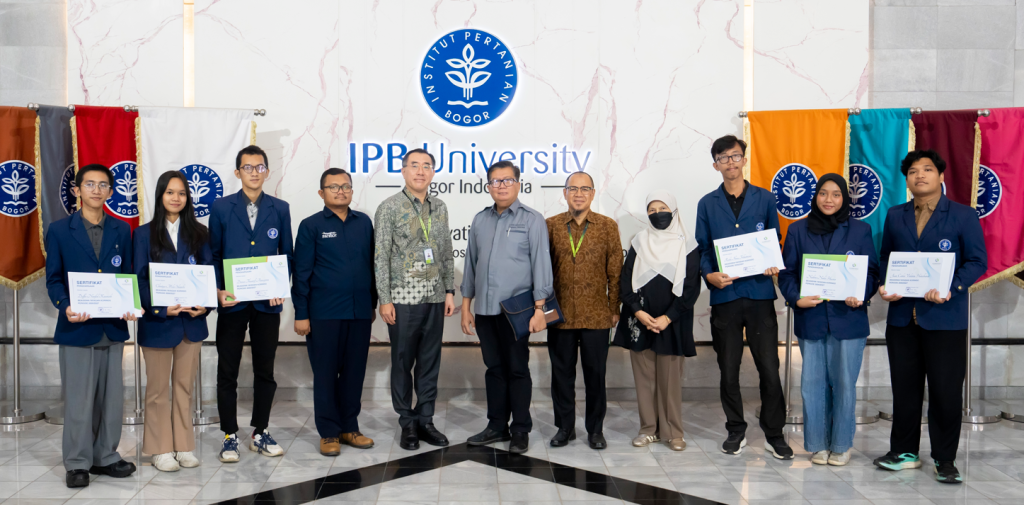
Photo: Dean at IPB University’s Forestry and Environment Faculty, Prof. Dodik Ridho Nurrochmat (in grey), stands alongside Korindo Foundation officials and scholarship awardees
BOGOR – Higher education should be accessible to all regardless of financial circumstances and places of upbringing. But in reality, college is not always affordable.
Here’s where scholarships come in. These financial aids expand access to tertiary learning, while ensuring educational justice is achieved in Indonesia.
They’re especially valuable at IPB University, most importantly the Faculty of Forestry and Environment. As part of a public institution with full autonomy, the faculty too enrolls students from various socioeconomic backgrounds. Some of them even come from families with limited means.
“Approximately 40% of our students are on scholarships,” said Prof. Dodik Ridho Nurrochmat, the faculty’s dean on Thursday (9/24/2026). “In terms of figures, they’re a lot, but that doesn’t mean their needs are all met.”
For him, not only those who meet the usual financial and academic requirements — as with KIP Kuliah and other government programs — should be awardees. There are others who can’t qualify despite facing financial issues, and they too need support, especially from a wide range of stakeholders, including the private sector and nonprofits, Prof. Dodik said.
“[Here,] we have kids who are financially disadvantaged but do not qualify for Bidikmisi or KIP Kuliah. These people are in need of support from stakeholders like Korindo Foundation.”
Cross-Subsidies and How Stakeholders Can Make Equitable Education Happen
This high demand for educational funding is closely tied to IPB University’s diverse student population. With a strong commitment to community development, particularly in rural areas, the school has attracted many lower-middle-income learners — who see it as an affordable option for getting a degree.
The offered financing schemes also hold great importance among these students as they keep them enrolled.
“[Instead of 40%,] there are over 50% or ideally 70%-80% whom I think should be on these programs now,” Prof. Dodik added. “Full-payers barely account for one-fifth of our students, which means the rest are subsidized. This makes cross-subsidy crucial alongside third-party scholarships, like that of Korindo Foundation.”
One of the initiatives that provide college opportunities for underprivileged children, this policy is strengthened by third-party support, part of a financing ecosystem that helps broaden financial assistance coverage.
In this regard, Korindo Foundation’s support will aid IPB University students — especially those needing additional funding — to continue their studies.
Ultimately, this will lead to a more equitable education system based on contributions from multiple sectors, not only universities. It’s so that money constraints do not stop people from pursuing education.
As more parties get involved, more doors will open — and education will finally allow young Indonesians to build their future. (PR)


